Following the footprints on the Moon
Whenever I look at the Moon, I always think of the Apollo-11 mission, of Neil Armstrong and Buzz Aldrin walking on its surface, and Michael Collins, waiting alone in orbit around it. I imagine that they are there right now, on the Moon, and that I could be watching them. How incredible that would be. Had I lived 53 years ago and witnessed it firsthand, I would have felt lucky just for that. Perhaps if I tell you the story, the adventure of these three Moon travelers, you’ll share the same feelings with me.
—
APOLLO PROGRAM. Starting in the 1950s, during the Space Race between the USSR (Soviet Union) and the USA (United States), the USSR maintained its lead, achieving a string of firsts: the first satellite, the first cosmonaut, and the first human to step into open space. The USA was behind. Until they aimed for the Moon.
Apollo Program patch
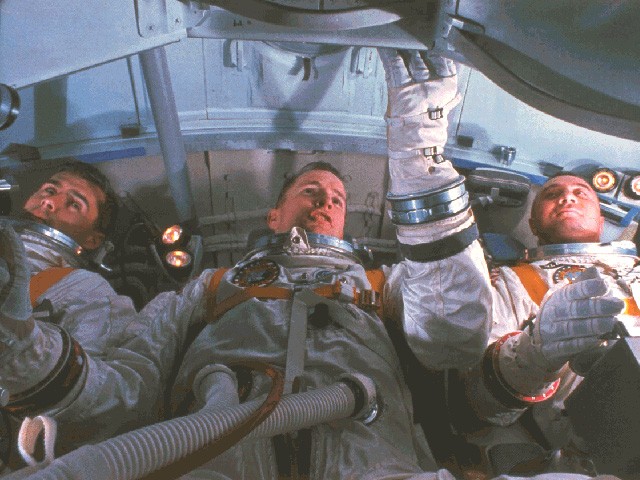
The Apollo program was a space initiative developed by the United States and carried out by NASA, with the goal of landing humans on the Moon. Preparations began in 1961, and the objective was finally achieved in 1969. However, success did not come without loss. During preparations for Apollo-1, considered the program’s first mission, a technical failure during a test on January 27, 1967, caused a fire on the launch pad. The astronauts Virgil Grissom, Edward White, and Roger Chaffee tragically lost their lives in the accident. Following this disaster, NASA decided to conduct all missions up to Apollo-7 without a crew on board.
The crew of the Apollo-1 mission during testing
The first manned and successful test flight took place on October 11, 1968. The mission, called Apollo-7, aimed to test in Earth’s orbit the rocket that would eventually carry astronauts to the Moon. Two months later, on December 21, Apollo-8 was launched, sending the same rocket toward the Moon to prove its capability.
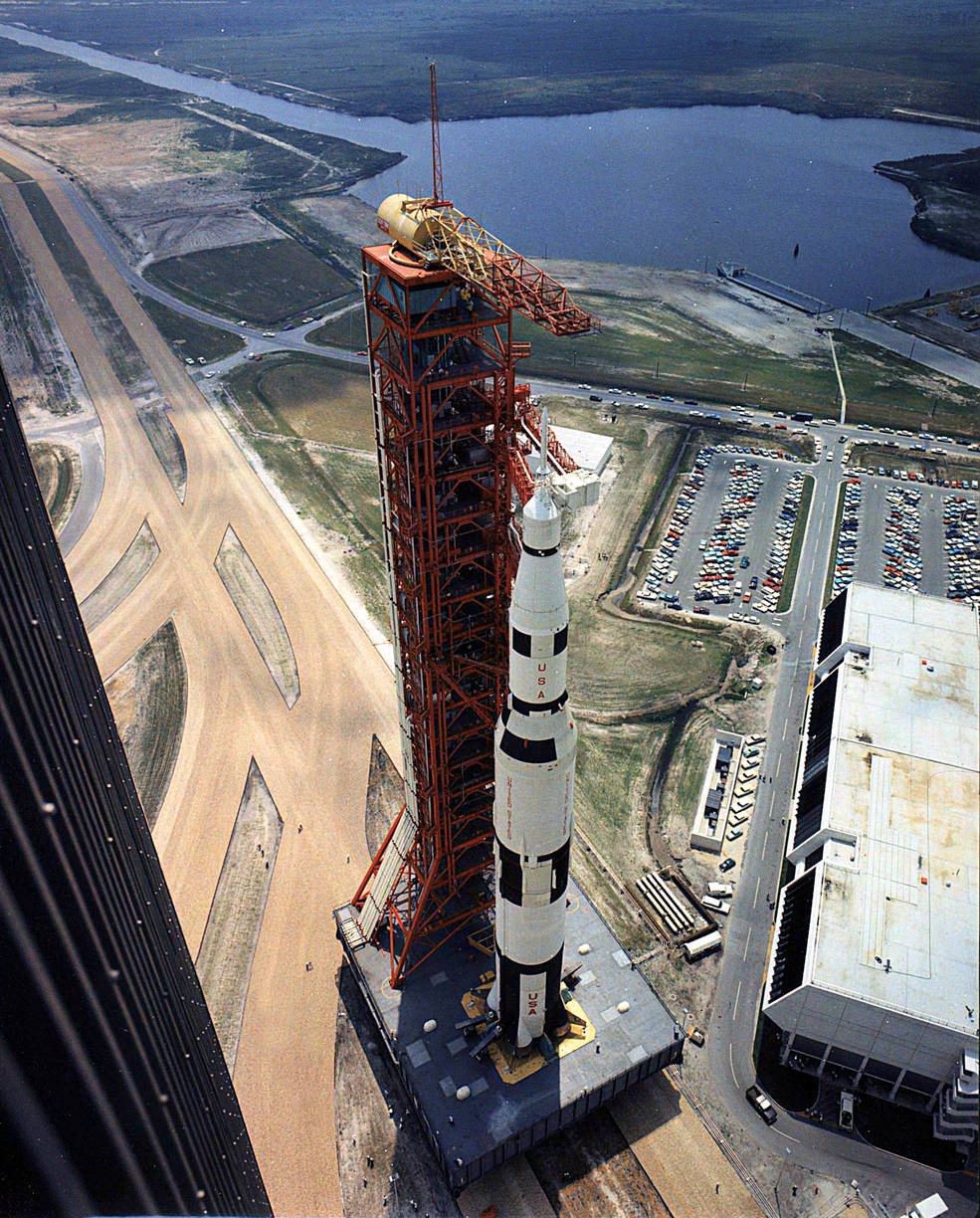
THE MASSIVE AND POWERFUL SATURN-V ROCKET. The rocket used in the Apollo program to carry humans to the Moon was called the Saturn V (or Saturn-5). To this day, it remains the most powerful and enormous rocket. Its height reached 111 meters. To visualize its enormity, imagine stacking four Maiden Tower (28 meters) on top of one another.
The rocket used in the Apollo program to carry humans to the Moon was the Saturn V (or Saturn-5)
The Saturn-V rocket consisted of 3 stages:
The first stage – the part responsible for overcoming Earth’s gravity and lifting the rocket to a certain altitude – was equipped with five F-1 engines. These engines completed their mission just 2 minutes and 41 seconds after liftoff and then separated from the other stages. During this time, the five F-1 engines consumed over 2,000 tons of fuel (RP-1, a type of kerosene, and liquid oxygen), propelling the rocket to an altitude of 68 km.
The mission of the second stage was to take the next stage into space. Like the first stage, it was equipped with five engines, but of a different type. After completing its mission with five J-2 engines, the second stage also separated from the rocket’s third and final stage. This separation occurred in the 9th minute of the flight. The J-2 engines used liquid hydrogen and liquid oxygen as fuel.
The third stage, with the help of a single J-2 engine, had the task of carrying the modules located at its top first into Low Earth Orbit and then onto a trajectory toward the Moon over approximately four and a half hours, after which it had to separate from the section carrying the modules.
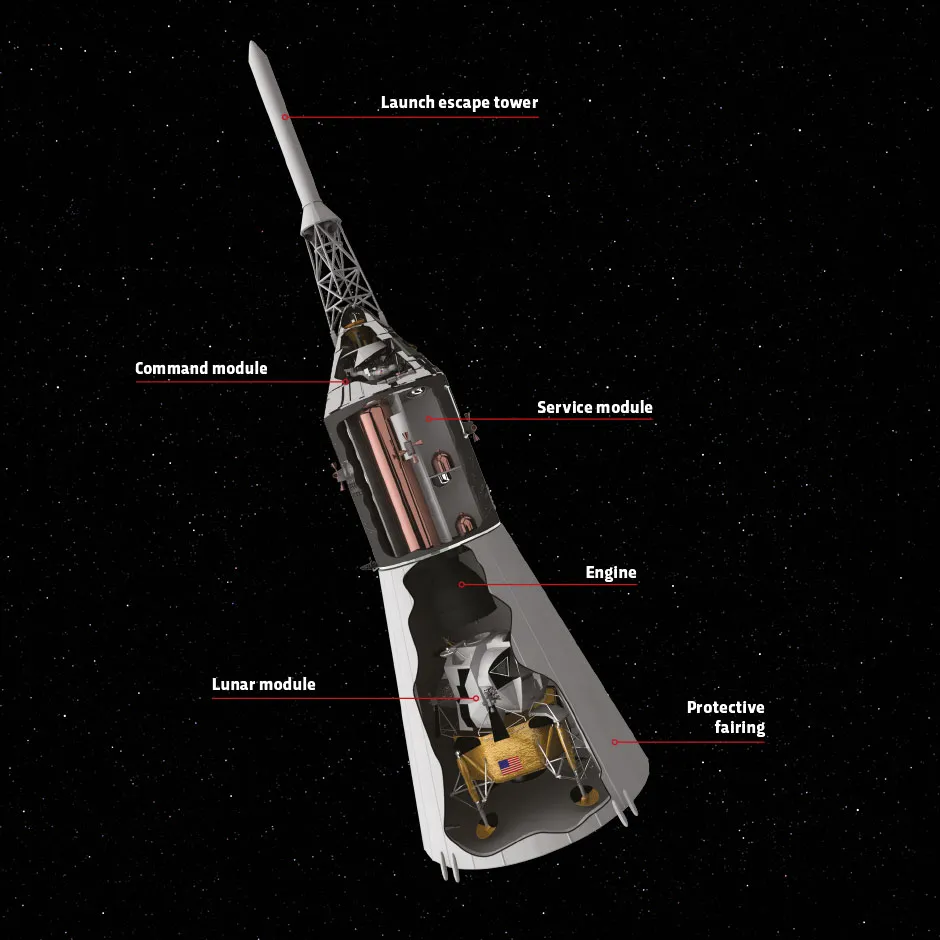
The modules located at the top of the Saturn-V rocket were: the Lunar Module called Eagle, which would land the astronauts on the Moon; the Service Module, equipped with life support systems, fuel, and an engine; and the Command Module, named Columbia, where the crew stayed throughout the flight. On top of these modules was the Launch Escape System (or Launch Abort System), which acted like a catapult in case of an explosion at launch, allowing the crew to leave the rocket immediately. Among these modules, the Command Module Columbia was the one that would return to Earth and bring the crew back safely.
Module placement at the top of the rocket
On March 3, 1969, during the Apollo-9 mission, the Lunar Module that would later be used in the final stage was tested in Earth orbit. Then, on May 18, a full dress rehearsal of all phases of the journey to the Moon (except the actual lunar landing) was carried out during Apollo-10. This was the final test before the historic Apollo-11 mission.
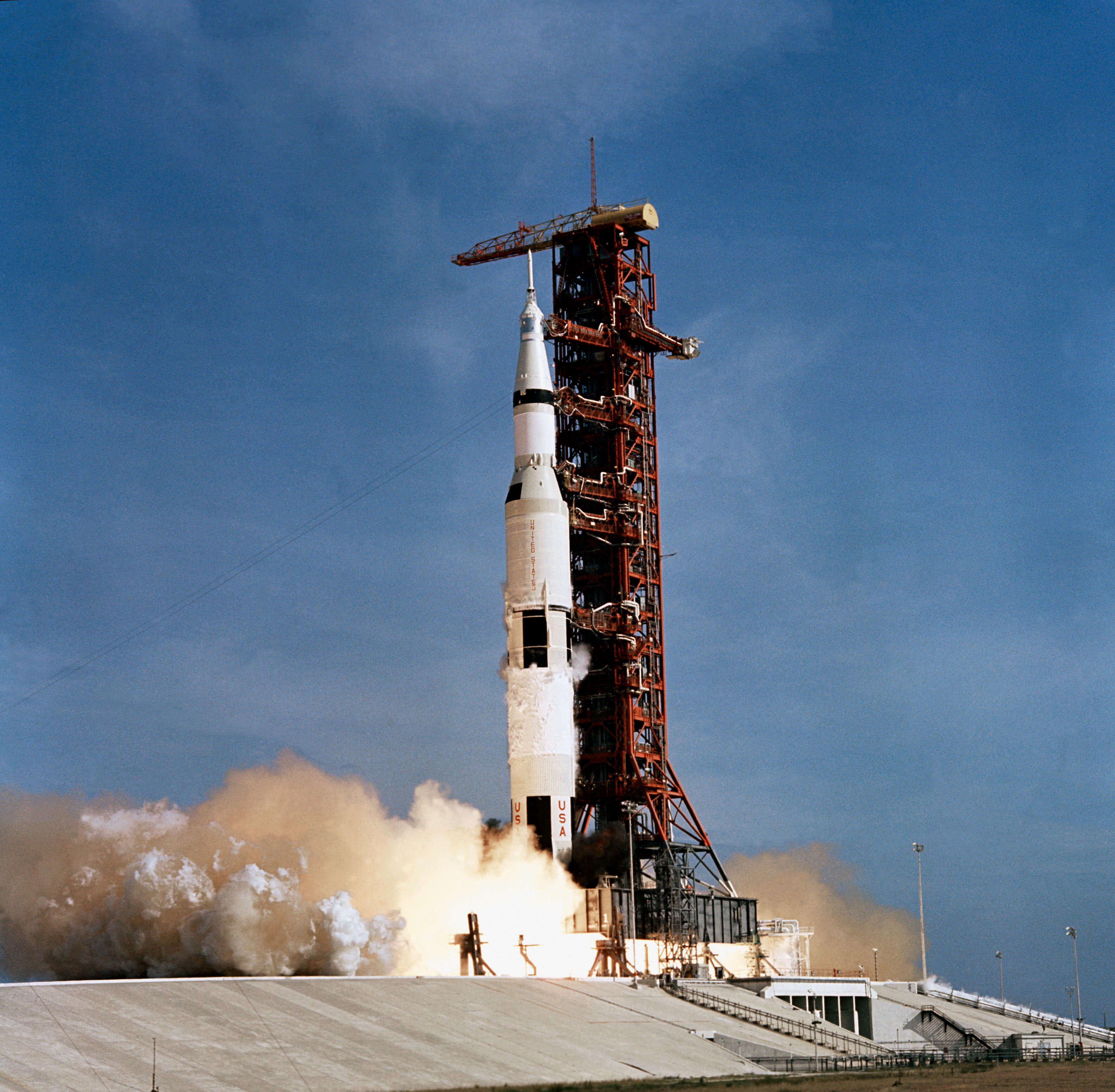
THE APOLLO-11 MISSION. LIFTOFF FROM EARTH. The calendar showed July 16, 1969. At Launch Complex 39-B of the Kennedy Space Center in Florida, the Saturn-V rocket was ready for its journey to the Moon. The mission commander Neil Armstrong, Lunar Module pilot Buzz Aldrin, and Command Module pilot Michael Collins eagerly awaited departure from Earth.
At 13:32 UTC, the engines of the Saturn-V rocket ignited. The mission was underway. The historic journey to the Moon had begun.
Apollo-11 mission, liftoff of the Saturn-V rocket from Earth
IN LUNAR ORBIT. After a 76-hour journey, the crew reached the Moon’s orbit. 100 hours into the mission, Neil and Buzz transferred to the Lunar Module for landing. A few hours later, the mission entered an untested phase: the descent to the Moon. Although they knew theoretically how the landing would proceed and understood the module’s operation, no one could be completely certain what would happen in reality. The Lunar Module had never been tested on the Moon’s surface. Still, the tests conducted on Earth and in lunar orbit, along with the calculations made, would enable them to become the first humans to walk on the Moon.
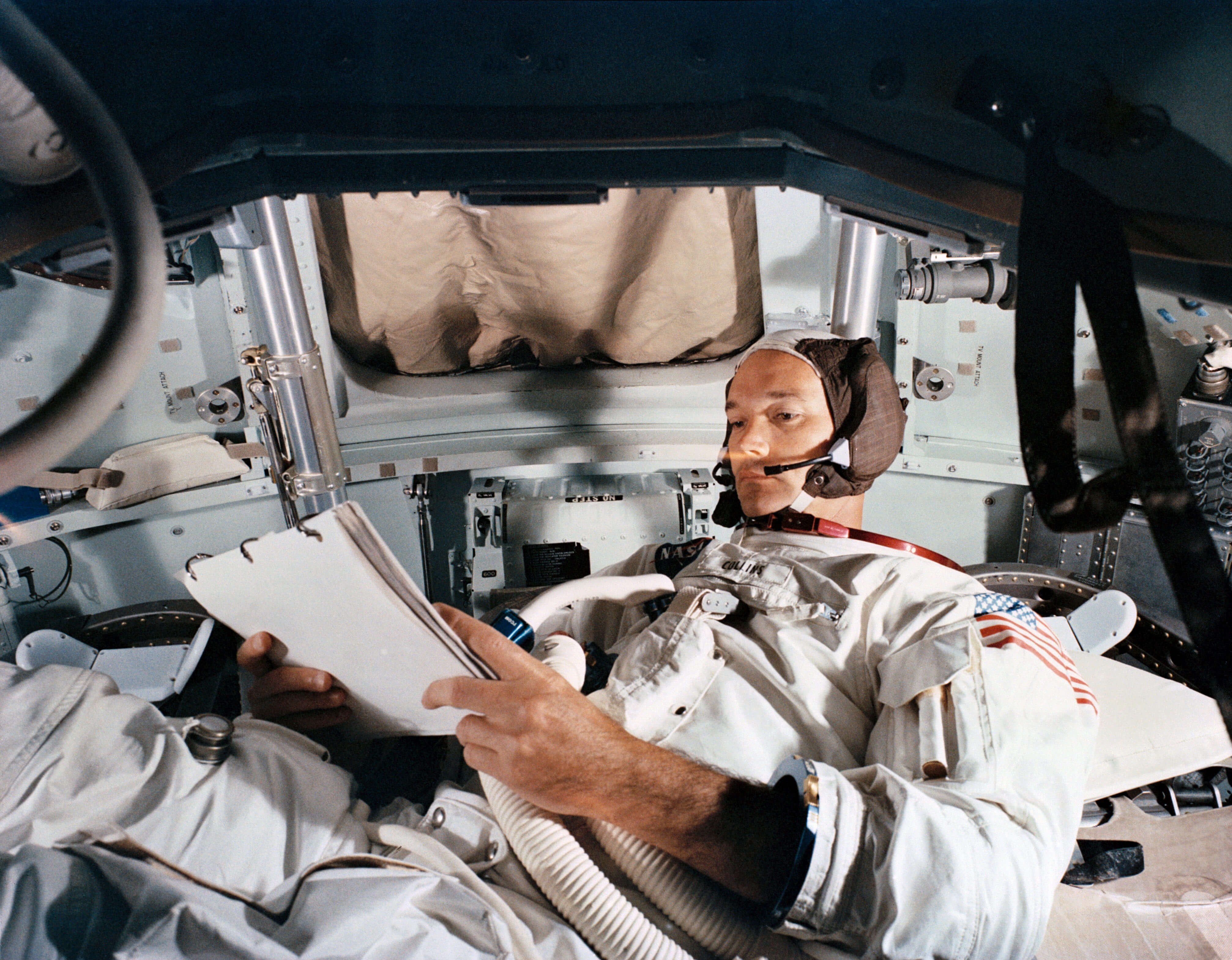
When Neil and Buzz began the descent in the Lunar Module named Eagle, Michael had to stay behind in the Command Module. By design, one astronaut had to remain in lunar orbit, managing the module that would bring the crew back to Earth. He would later have to rendezvous with the Lunar Module and dock it to the Command Module after Neil and Buzz returned from the Moon. That astronaut was Michael. Thus, spending time alone in the module, he became known in history as the loneliest human, in space.
Michael Collins, in the simulator of the Command Module he piloted, during training
Michael, the secret hero of the Apollo-11 mission, lost all contact with both Earth and the astronauts on the Moon for a while when he passed over the Moon’s dark side.
"Friends, keep talking to me..."
These were the last words he managed to convey to his friends before the communication blackout. Upon returning to Earth, he described these silent moments not as frightening, but as thrilling and deeply inspiring.
MOON LANDING. Meanwhile, Neil and Buzz landed on the Moon. They touched down in the southwestern area, which they named Tranquility, or the Sea of Tranquility, a calm, previously unvisited land where no human had ever set foot.
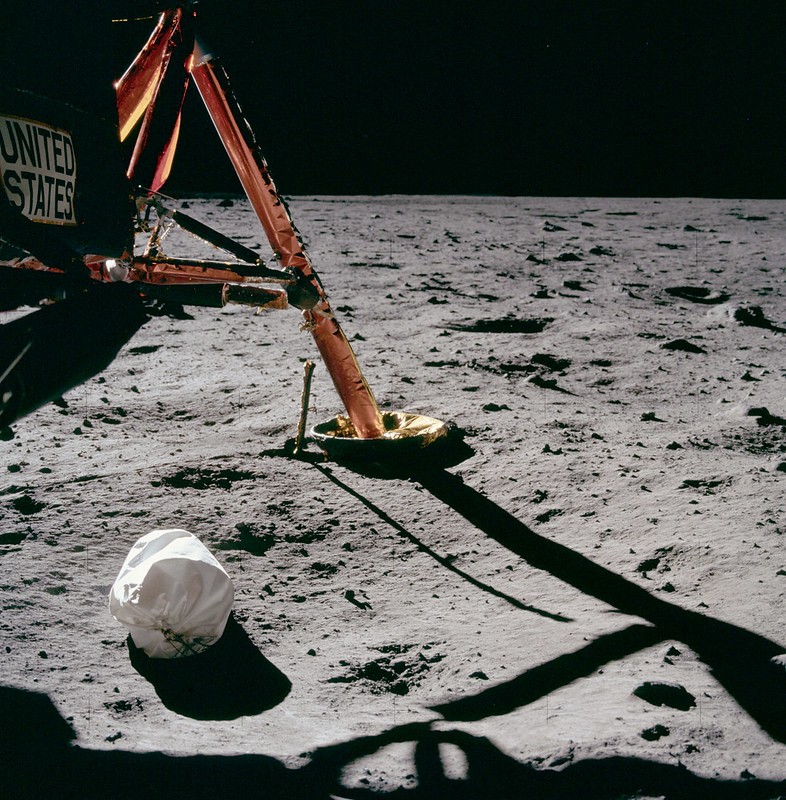
The first photo taken on the Moon with a Hasselblad camera. The white bag visible near the Lunar Module’s foot is a trash bag used by the crew inside the module, which they tossed outside as they began their descent toward the Moon.
109 hours, 24 minutes, and 15 seconds after leaving Earth (July 20, 1969), Neil took the historic step, becoming the first human to walk on the surface of another celestial body. As Neil said, it was “a small step for [a] man, a giant leap for mankind.” Billions of people around the world witnessed the moment. Television broadcast it live. The inspiring, hopeful step marked the beginning of other great future milestones, and people everywhere celebrated the joy of this achievement.
Twenty minutes after Neil’s first step, Buzz joined him. Together, they walked on the Moon’s surface, collected soil samples for research, set up the scientific equipment they had brought from Earth, and took numerous photos to capture the moment.
Buzz Aldrin, with Neil Armstrong's reflection in the glass of his spacesuit
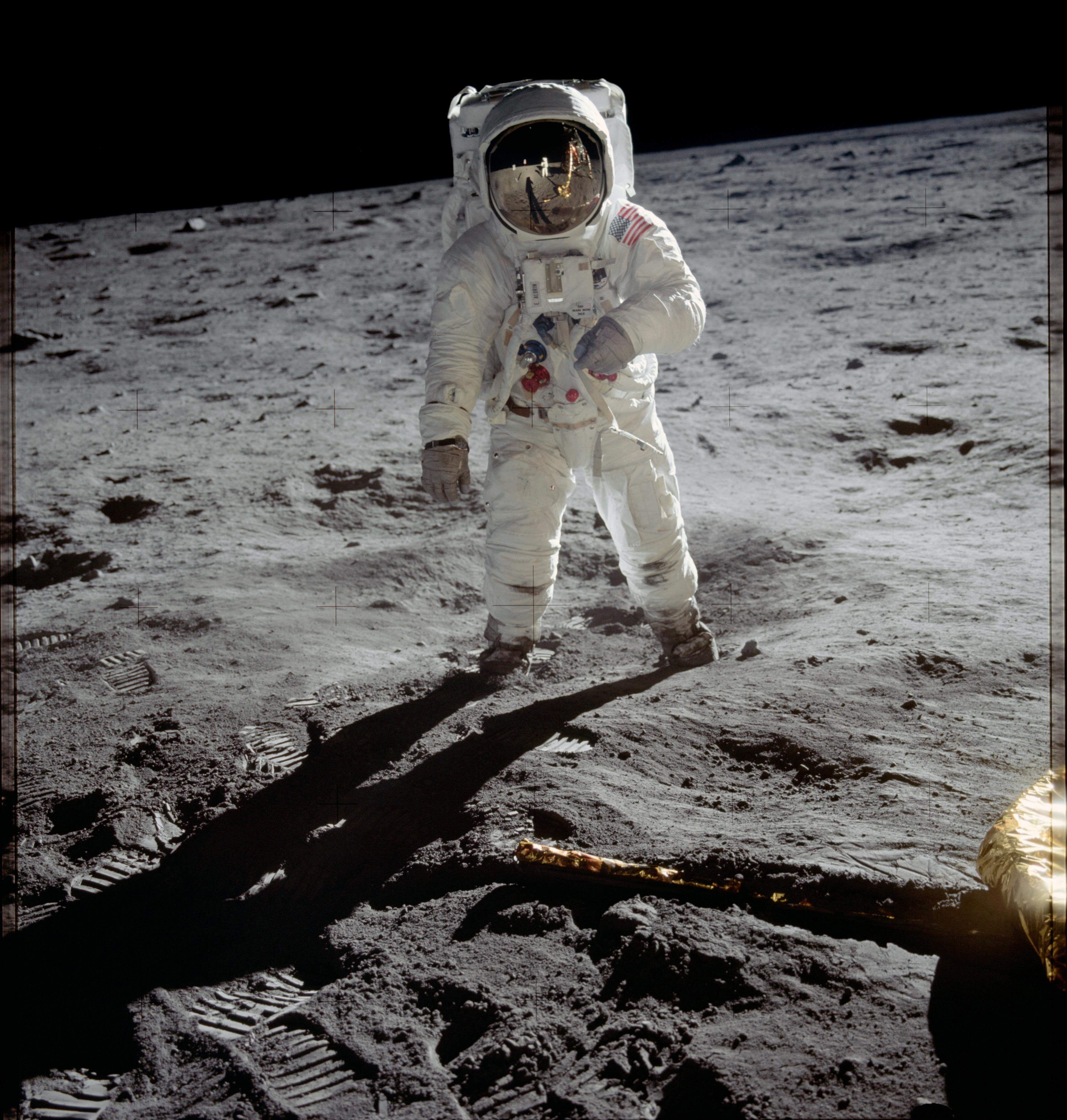
Perhaps because of his confidence in his photographic skills, Neil is the author of nearly all the pictures taken on the Moon. The camera that assisted him was specially designed for shooting on the Moon by Hasselblad.
Among the scientific-experimental equipment set up by the astronauts on the Moon were a passive seismograph to measure lunar quakes, a laser reflector to determine the distance between Earth and the Moon, and tools necessary to measure solar winds.
Also, erecting the American flag on the Moon was another task that Neil and Buzz had to complete. However, in addition to that, a plaque must have been installed to signify that the Apollo project was for humanity and that they came to the Moon for peace. Although it had not been thought out beforehand, the erection of the flag caused another country’s peoples to be left with the impression that the USA owned the Moon, leading to controversies, so such a solution was proposed. The flag was planted simply as a symbolic gesture of national pride. During this period, US President Richard Nixon established radio communication and had a phone call with Armstrong and Aldrin, which was recorded as the "most historical phone call from the White House" at that time.
Buzz Aldrin, with Neil Armstrong’s reflection visible in the visor of his spacesuit as he took the photo
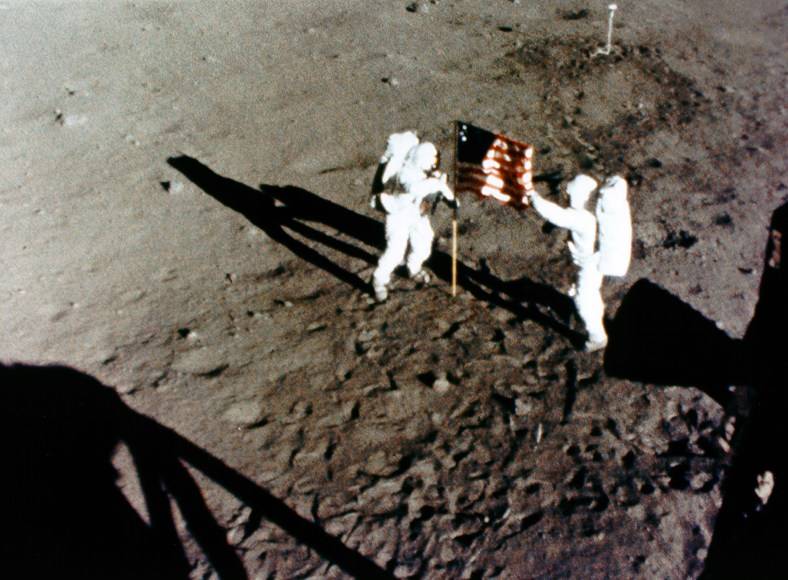
After spending 21 hours and 36 minutes on the lunar surface, both astronauts were ready to return to Earth. During that time, they had only been outside the Lunar Module, walking on the Moon, for 2 hours and 14 minutes. Now, it was time to go home.
RETURN TO EARTH. The Lunar Module would accompany Neil and Buzz back to lunar orbit. From there, they needed to rendezvous with the Command Module, where Michael awaited, for the journey back to Earth. This part of the mission, like the landing, had never been tested in actual lunar conditions. To lift off from the Moon, the Lunar Module fired its engines. Michael, watching his friends on their way home from lunar orbit, described his feelings at that moment:
“Since the first days of the mission, my fear has been leaving them on the Moon and returning to Earth alone. There are only minutes left until that fear passes.”
The eagerly awaited liftoff was successful. After a 4-hour flight, the astronauts, Neil and Buzz, reunited with Michael.
The Lunar Module had completed its mission, and the crew had to continue home without it. Once Neil, Buzz, and Michael were seated in the Command Module, the Lunar Module separated from it. The Service Module, which had been attached to the Command Module throughout the mission, fired its engines to leave lunar orbit. The crew was now on their way back to Earth.
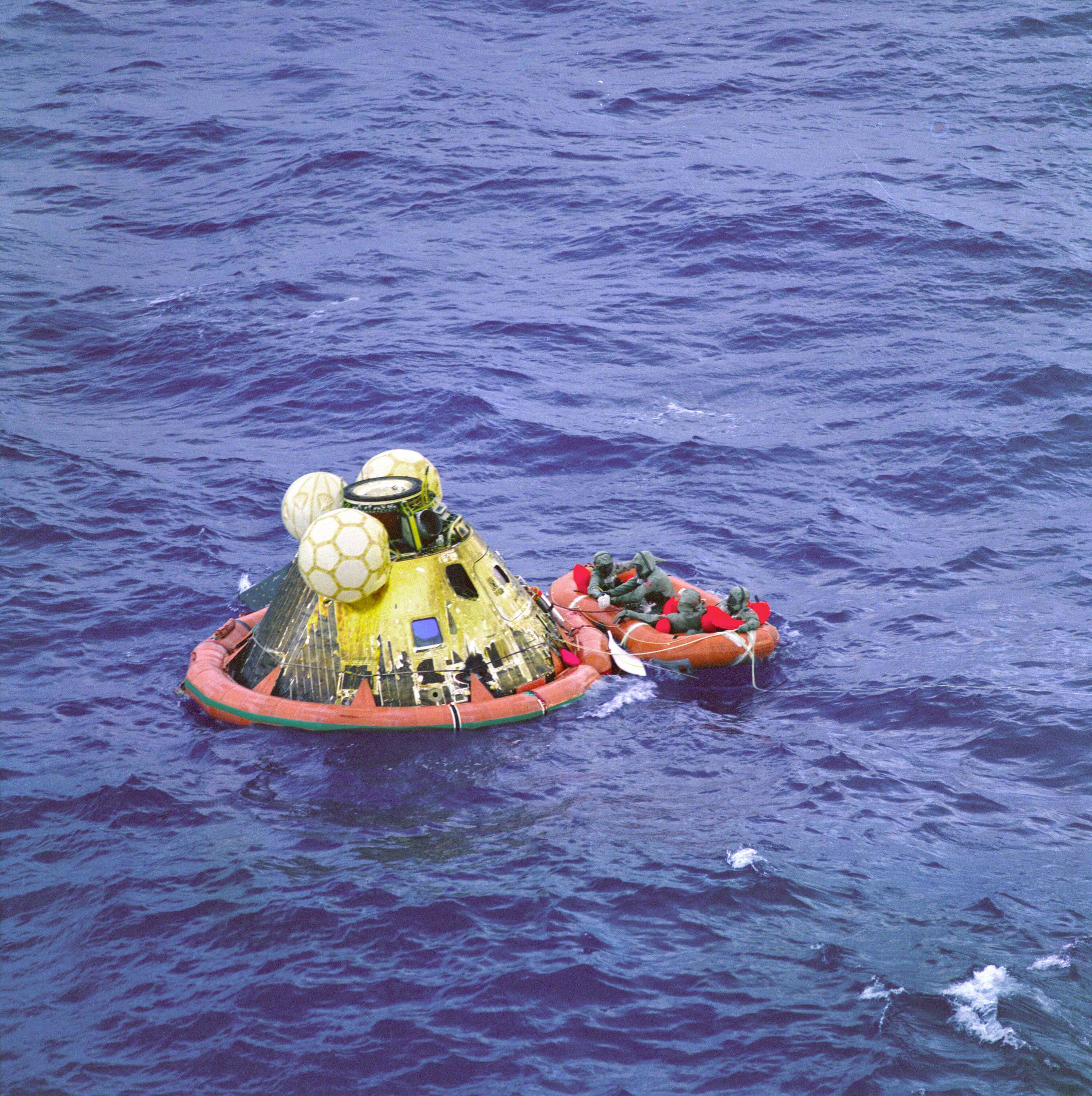
After a two-and-a-half-day journey, they reached Earth orbit. At this point, the Service Module, which had supplied power and energy to the Command Module during the mission, separated. Only the Command Module, carrying the crew, remained. Fifteen minutes after entering Earth’s atmosphere, the module splashed down in the Pacific Ocean. The date was July 24.
After the astronauts’ Command Module splashed down in the Pacific Ocean, they waited alongside their diver for a helicopter to arrive and pick them up.
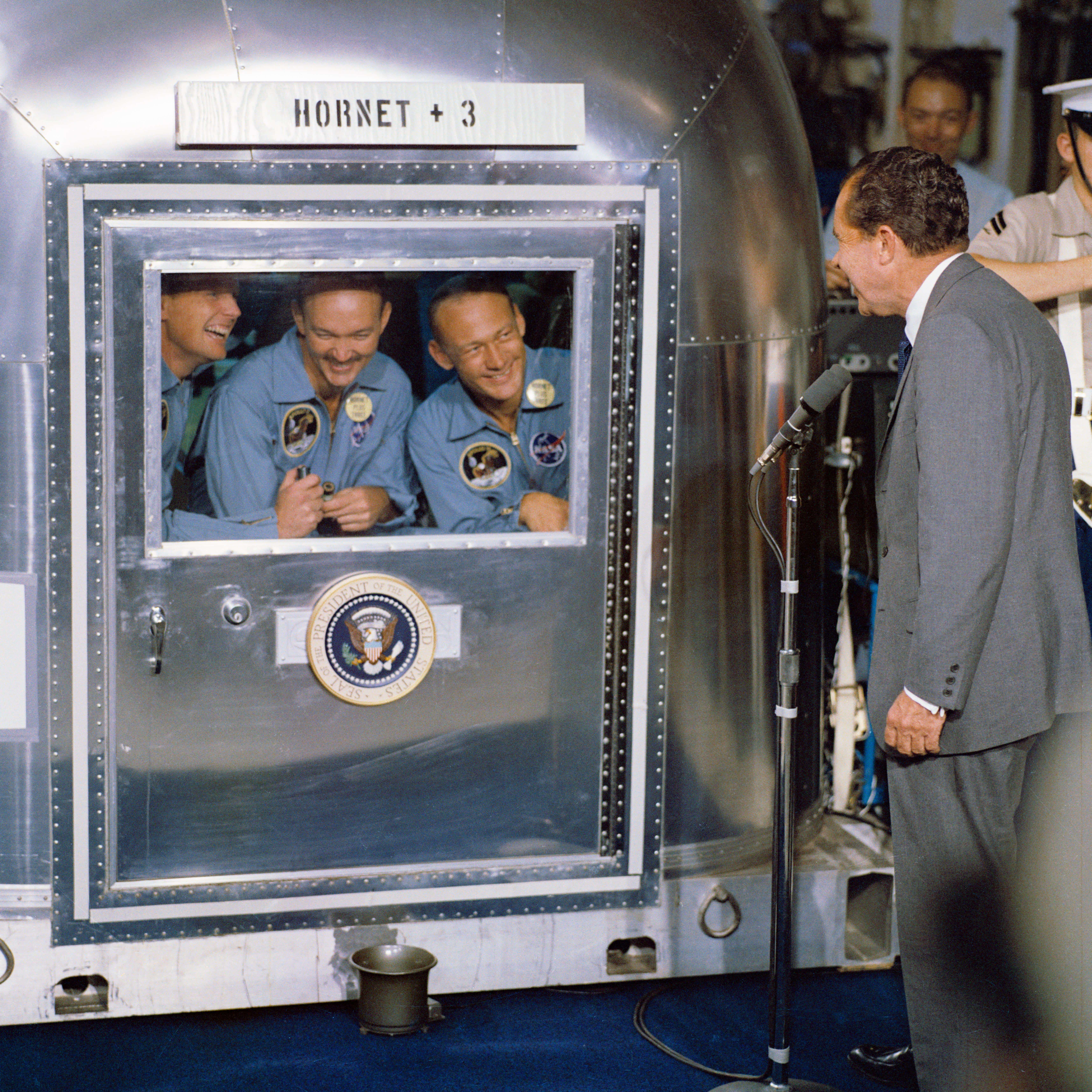
After the splashdown, the astronauts were placed in a two-week quarantine. Since no one had ever returned from the Moon before, the quarantine was necessary to monitor how the human body would react to the journey, to ensure that any unknown viruses from the Moon couldn’t infect the astronauts or people on Earth, and to control any potential abnormalities. The quarantine continued until August 10.
U.S. President Richard Nixon meeting with the astronauts during their quarantine
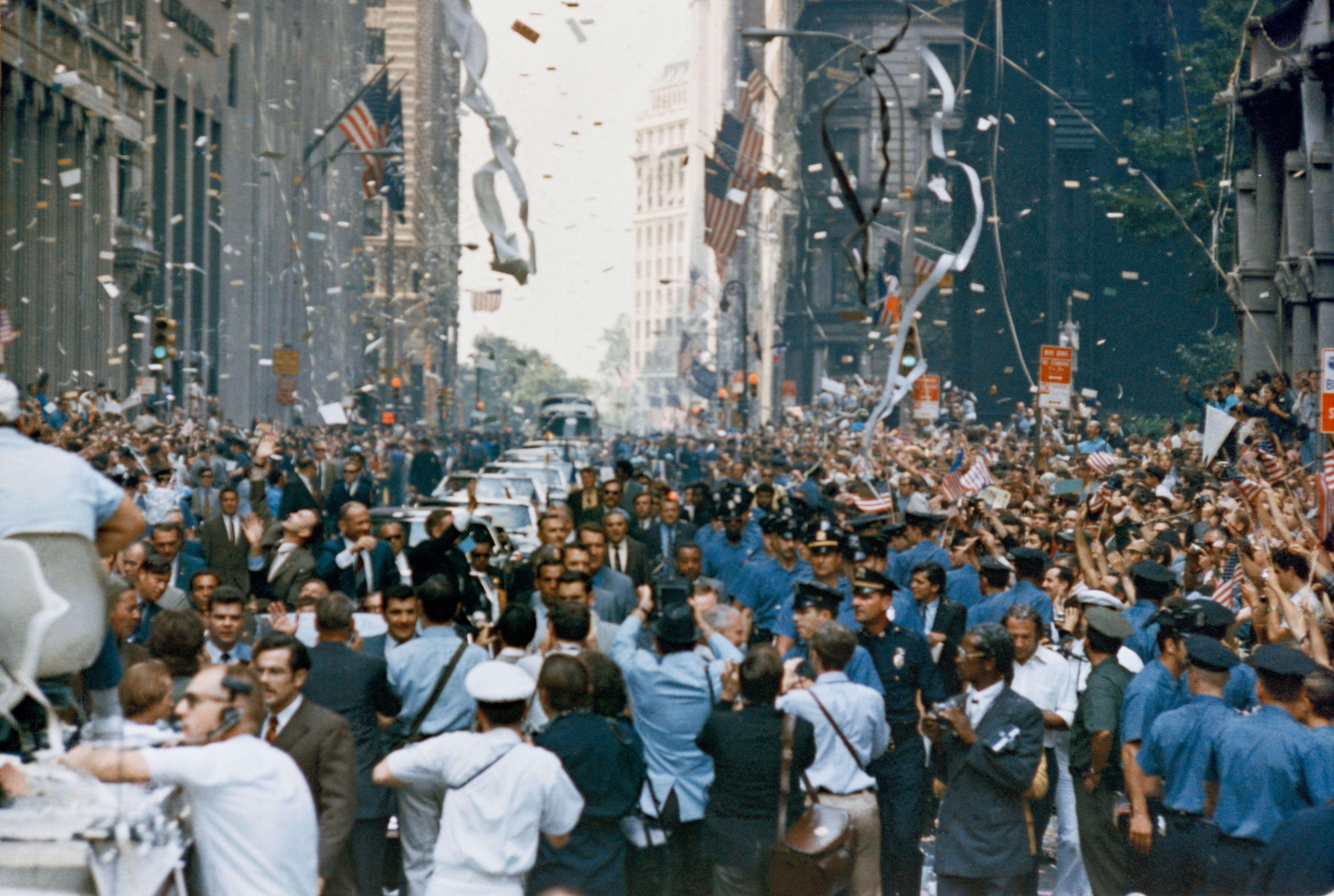
After completing quarantine with no abnormalities observed in their condition, the astronauts joined a parade to meet the public. People flooded the streets to see the Moon travelers, welcoming them with a grand celebration and ceremony. It was a success for all of humanity.
People flooded the streets to see the Moon travelers, greeting them with a grand ceremony and celebration. It was a success for all of humanity.
MISSION CONTINUED. Following humanity’s first Moon landing, the Apollo Program continued with six more missions. Only one of these missions did not result in a Moon landing. After the successful second landing with Apollo-12, the Apollo-13 mission experienced an in-flight explosion, forcing the crew to return to Earth without reaching the Moon. This event, historically called a “successful failure,” saw the landing attempt fail, yet the astronauts returned safely to Earth. Following a one-year break, the next four missions, Apollo-14, Apollo-15, Apollo-16, and Apollo-17, landed on the Moon and successfully completed their objectives. Due to budget constraints, the planned Apollo-18 and subsequent missions were canceled, making Apollo-17 the final mission of the Apollo Program.
—
Last, but not least, for more information and mission visuals, you can explore the following:
Real-time audio and video recordings from the start to the end of Apollo-11 (first Moon landing), Apollo-13 (no Moon landing), and Apollo-17 (final mission), click here;
An animated info-visual of the Apollo-11 Moon landing, click here;
Photo archives from the Apollo missions, click here or here.
—
It has been 50 years since humanity last set foot on the Moon, a half-century. Since then, no one has had the chance to witness a Moon journey live. But we do now. With the Artemis Program, humanity is returning to the Moon. This time, we aim to stay longer, permanently. Following the footprints on the Moon. Who knows, just as we now look up at the Moon, maybe one day we’ll look up at Earth too.
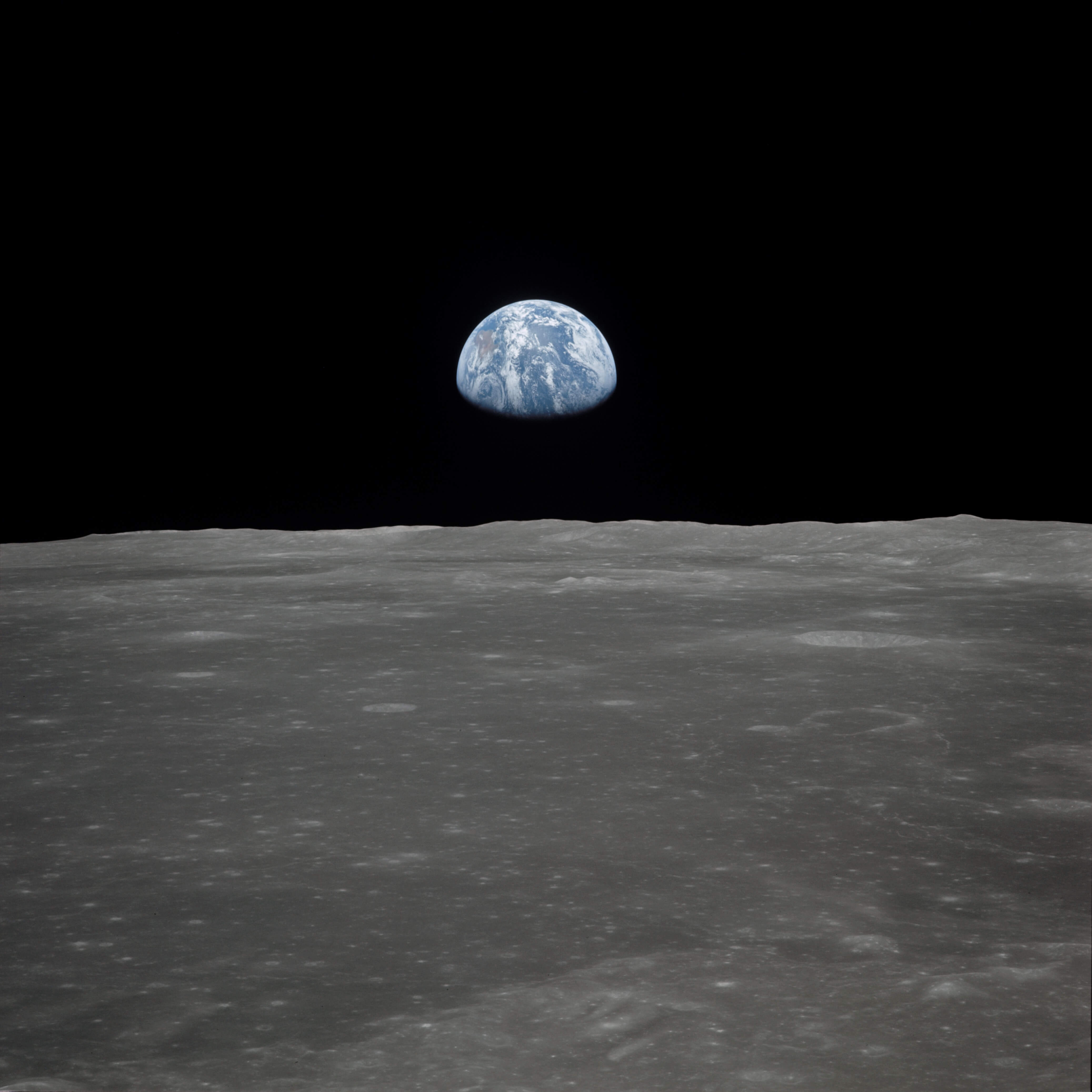
Earthrise, captured during the Apollo 8 mission
© 2026 Zəhra Kosmosda