CAPSTONE: Project of Firsts
"We choose to go to the Moon!"
In 1962, John F. Kennedy, the former president of the United States, made his famous speech. Sixty years later, we are choosing to go to the Moon again.
—
CAPSTONE PROJECT. Cislunar Autonomous Positioning System Technology Operations and Navigation Experiment (Cislunar Autonomous Positioning System Technology Operations and Navigation Experiment), briefly,CAPSTONE project, is a NASA mission developed in collaboration with several private companies to test technologies and orbits for humanity’s renewed journey to the Moon. It’s a project of firsts: an orbit never visited before, a payload delivered to higher orbits than ever, and a launch site never previously used for Moon-bound missions.
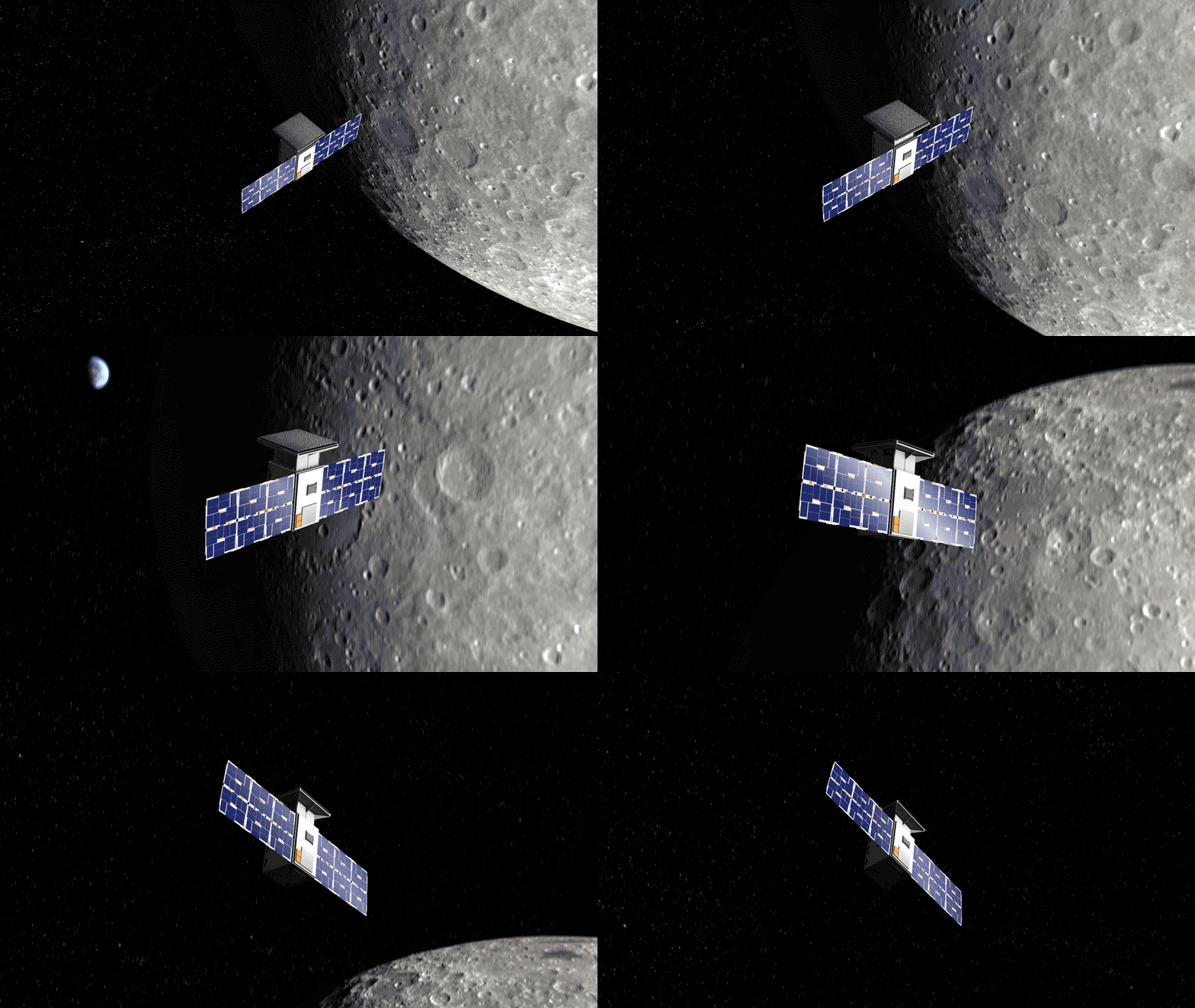
60 years ago, when we chose to go to the Moon, there wasn’t a clear answer to the “how?” question. All we had was curiosity and the thrill of exploring new places. Over half a century later, we now have much more than we had back then. Now, we can give a solid answer to “how?”, and we are even searching for something better. That is exactly what CAPSTONE will do.
The satellite, sharing its name with the project, weighs 25 kilograms and is roughly the size of a microwave oven. Its development involved collaboration among five private companies with NASA funding, each responsible for specific aspects of the mission:
Advanced Space - mission development and management;
Terran Orbital - satellite design and assembly;
Stellar Exploration - propulsion subsystem (providing the satellite with thrust in space);
Tethers Unlimited - radio communication systems;
Rocket Lab - launch of the satellite into space.
CAPSTONE, which started its preparation work in 2019, was launched into space on June 28 at 12:55 local time (Baku +4 GMT) from the Mahia Peninsula in New Zealand using a rocket carrier called Electron. Both the rocket and the launch site belong to Rocket Lab, one of New Zealand’s first private space companies.
Just to clarify, the Electron rocket is primarily designed to place small-sized satellites into low Earth orbit (LEO). Its three-stage design includes a Photon module in the third stage, which carries CAPSTONE. Over the six days following launch, this module’s job is to place the satellite into the correct orbit and help it escape Earth’s gravity. After that, CAPSTONE continues its four-month journey toward the Moon on its own. According to calculations, it is expected to reach the Near Rectilinear Halo Orbit (NRHO) around November 13.
CAPSTONE's MOON JOURNEY. If this all sounds a little confusing, that’s great! Because now we’ll travel together, from Earth to the Moon, using the visual guide below, and everything will become much clearer. Ready? Let’s go!
CAPSTONE's step-by-step journey to the Moon
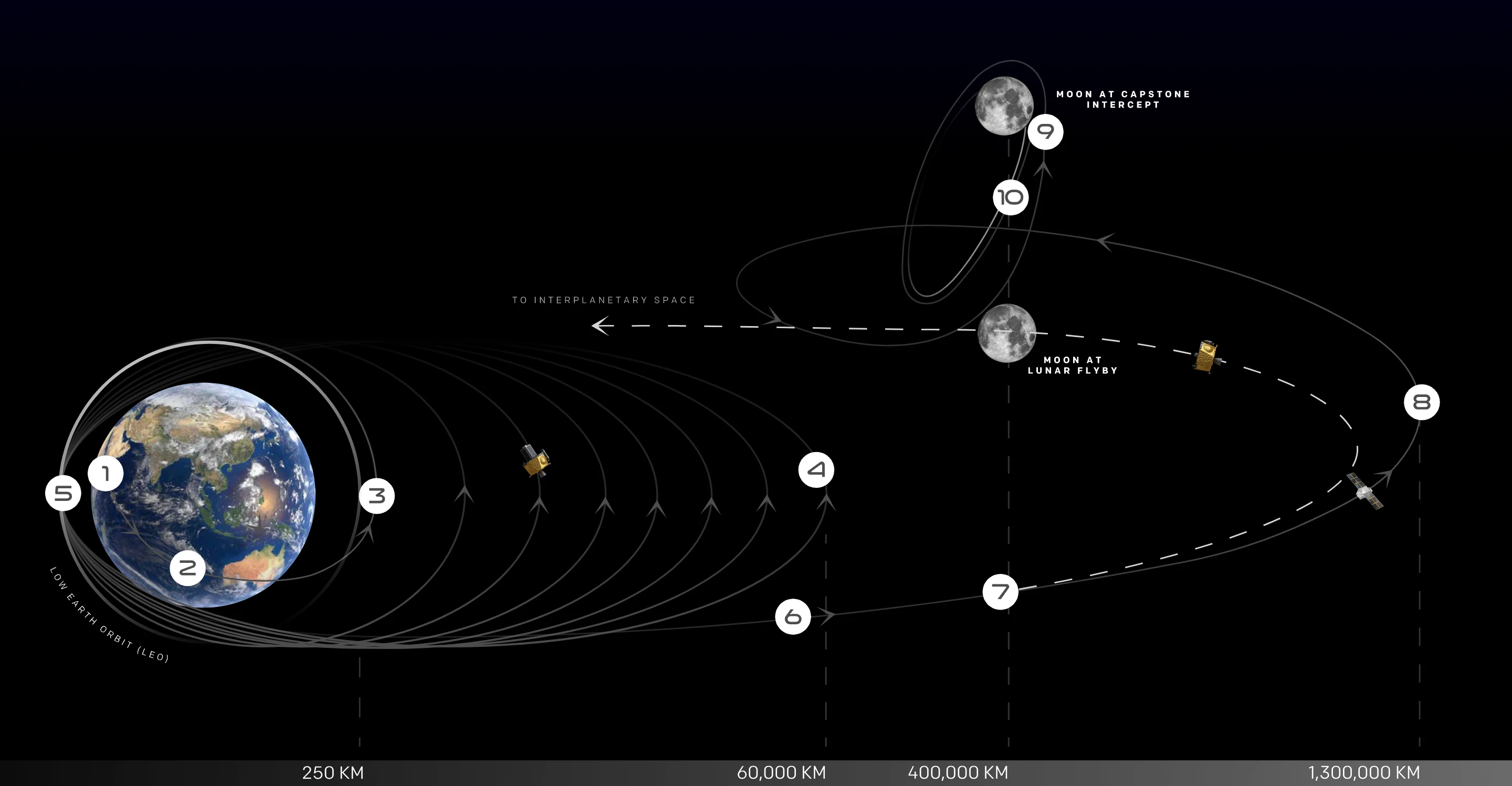
Launch. The Electron rocket sends CAPSTONE toward the Moon;
Photon separation. 9 minutes after launch, the Photon module separates from the rocket’s second stage;
Entry into LEO. Photon enters a LEO at 250 km altitude;
Orbit raising maneuvers. The HyperCurie engines, named in honor of Marie Curie and designed with 3D printing technology, periodically adjust Photon’s orbit, raising it from LEO to a higher orbit;
Trans-lunar trajectory insertion. At this point, the HyperCurie engines accelerate Photon to 11 km/s, escaping Earth’s gravity and entering the trans-lunar trajectory;
CAPSTONE separation. Finally, after 6 days together, CAPSTONE separates from Photon and continues alone on its ballistic lunar trajectory;
Photon’s final burn. After separation, Photon fires its engines one last time to fine-tune its trajectory, passes by the Moon, and enters interplanetary space;
CAPSTONE farther out. At 1.3 million km from Earth, CAPSTONE uses the Sun’s gravity to adjust its path and heads directly toward the Moon;
Countdown. Using the hydrazine fuel it carries, CAPSTONE fires its engines and enters NRHO;
Happy Ending. After a long journey of 4 months, CAPSTONE settles into a stable lunar orbit (NRHO) and begins gathering data.
NEAR RECTILINEAR HALO ORBIT - NRHO. Huh! It's a long journey, isn't it? But you might wonder, why take such a long route over several months when there is an option to go to the Moon in just a few days?
When we say CAPSTONE is a project of firsts, one of the things meant is that the path it takes and the orbit it will reach, called NRHO (Near-Rectilinear Halo Orbit), has never been explored by any spacecraft before. The goal is exactly that: discovery!
In the stretched, elongated elliptical orbit of NRHO, CAPSTONE will complete each orbit in roughly one week, and this will continue for at least six months. Of course, throughout these orbits, it will stay in constant contact with Earth, sending the collected data for analysis. This period is considered the ideal time to study the targeted orbit.
In the stretched, elongated elliptical orbit of NRHO, CAPSTONE will complete each orbit in approximately one week.

Since NRHO is more stable and resilient (according to scientists’ calculations), a spacecraft moving around the Moon in this orbit will save a significant amount of fuel. Ballistic Lunar Trajectory used to reach this orbit also requires less fuel, which means the overall mission costs will be considerably lower, and more payload can be delivered to the lunar orbit with less fuel. In this way, the realization of a future Lunar Orbital Station comes several steps closer to us.
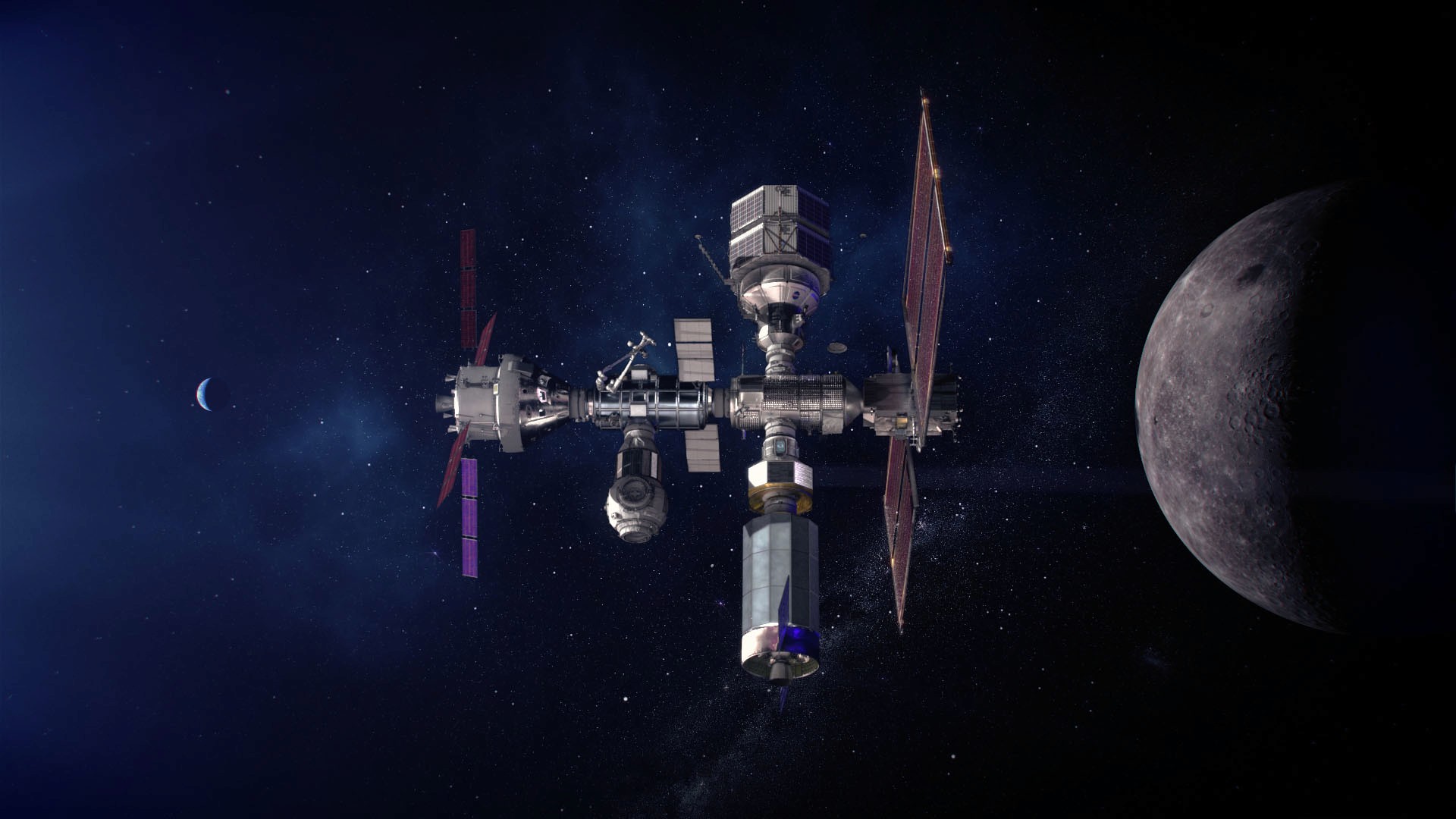
Gateway is the name given to the Lunar Orbital Station that NASA plans to use as a waypoint for sending humans back to the Moon as part of the Artemis Program. The station will serve multiple purposes: it will act as a docking point for various spacecraft, provide living quarters, enable scientific research, and continuously receive cargo and logistics modules to support Moon-bound missions. You might think of the International Space Station orbiting Earth; Gateway is similar, but instead of Earth, it orbits the Moon. And CAPSTONE is currently exploring the NRHO orbit where Gateway is planned. If the project succeeds and NRHO proves to be as stable, resilient, and fuel-efficient as scientists expect, this orbit could support Gateway operations around the Moon for at least 15 years.
Gateway, the Lunar Orbital Station that will serve as a waypoint for NASA’s Artemis mission, which aims to send humans back to the Moon
CAPSTONE, DO YOU HEAR US? Another mission assigned to CAPSTONE is to establish communication with the Lunar Reconnaissance Orbiter (LRO), a satellite sent to the Moon in 2009 that still orbits it today. If communication is successful, the two spacecraft can “talk” to each other, determine their positions relative to one another, and continue their paths independently, without needing to be tracked from Earth.
Currently, communication with CAPSTONE is maintained through NASA’s Deep Space Network (DSN), a set of massive radio antennas renowned for their ability to contact spacecraft located extremely far away. However, occasional interruptions can occur due to issues either on the spacecraft or with the ground antennas. After CAPSTONE separated from the Photon module, a brief communication connection issue occurred, but communication was quickly restored, and it was reported that this interruption did not significantly affect the mission’s progress.
By the way, you can check the details of the CAPSTONE connection with the DSN via this link, and to track CAPSTONE's current location, you can simply click here.
—
We’ve shared another cosmic journey together. Maybe in the coming decades, we’ll visit the very places CAPSTONE is exploring, and from the spacecraft’s window, as we approach the Moon, we’ll hum this song:
Fly me to the moon
Let me play among the stars
Let me see what spring is like on
A-Jupiter and Mars

—
Artemis Program - NASA’s initiative to return to the Moon after decades and land the first woman and first Black astronaut on its surface
Lunar Reconnaissance Orbiter (LRO) - a NASA satellite used to map the Moon, which has been orbiting the Moon since June 18, 2009
Deep Space Network (DSN) - a network of massive radio antennas used to communicate with interplanetary spacecraft. It’s also used for contact with several Earth-orbiting satellites and for astronomical observations to gather data from the farthest reaches of our Solar System.
© 2026 Zəhra Kosmosda