Search for extraterrestrial life
At first glance, it might seem that biology has answered the question “What is life?” in a way that leaves no doubt or hesitation. The fundamental axiom that all living things are made up of cells is often considered a simple and sufficient answer to understand this concept. For most known life forms on Earth, this holds. However, things get complicated when we come to viruses. Although viruses exhibit typical characteristics of life, they cannot act as independent units; they lack cytoplasm, enzymes, and their own replication mechanisms.
On Earth, there are life forms even stranger than viruses: prions. A prion doesn’t resemble any kind of cellular structure at all. This simple, extremely small entity, known as the cause of mad cow disease, is actually a protein that normally exists in the brain with a regular function. When its disease-causing form appears through some mechanism, it triggers a chain reaction where other normal proteins begin to change and resemble it, turning into prions. In this way, a prion effectively reproduces itself, replicates.
When we try to extend biology’s concept of life beyond Earth - into astronomical scales - the thread, in a sense, slips out of the hands of biologists and into those of physicists and mathematicians.
The most important thing a cell passes on to the next generation is information.
A universal definition of life should be built on the concept of information. On Earth, what we call cells, these tiny information-carrying micro-boxes, adapt to their environment and pass on the experience they accumulate for survival to the next generation, mainly through genetic material: DNA (deoxyribonucleic acid). But just as not every species of monkey evolves into a human (in mathematical terms, the probability is not zero, but negligibly small), the chance that primitive information-carrying molecules elsewhere in the Solar System would undergo evolution (chemical evolution) and turn into complex DNA is also very low.
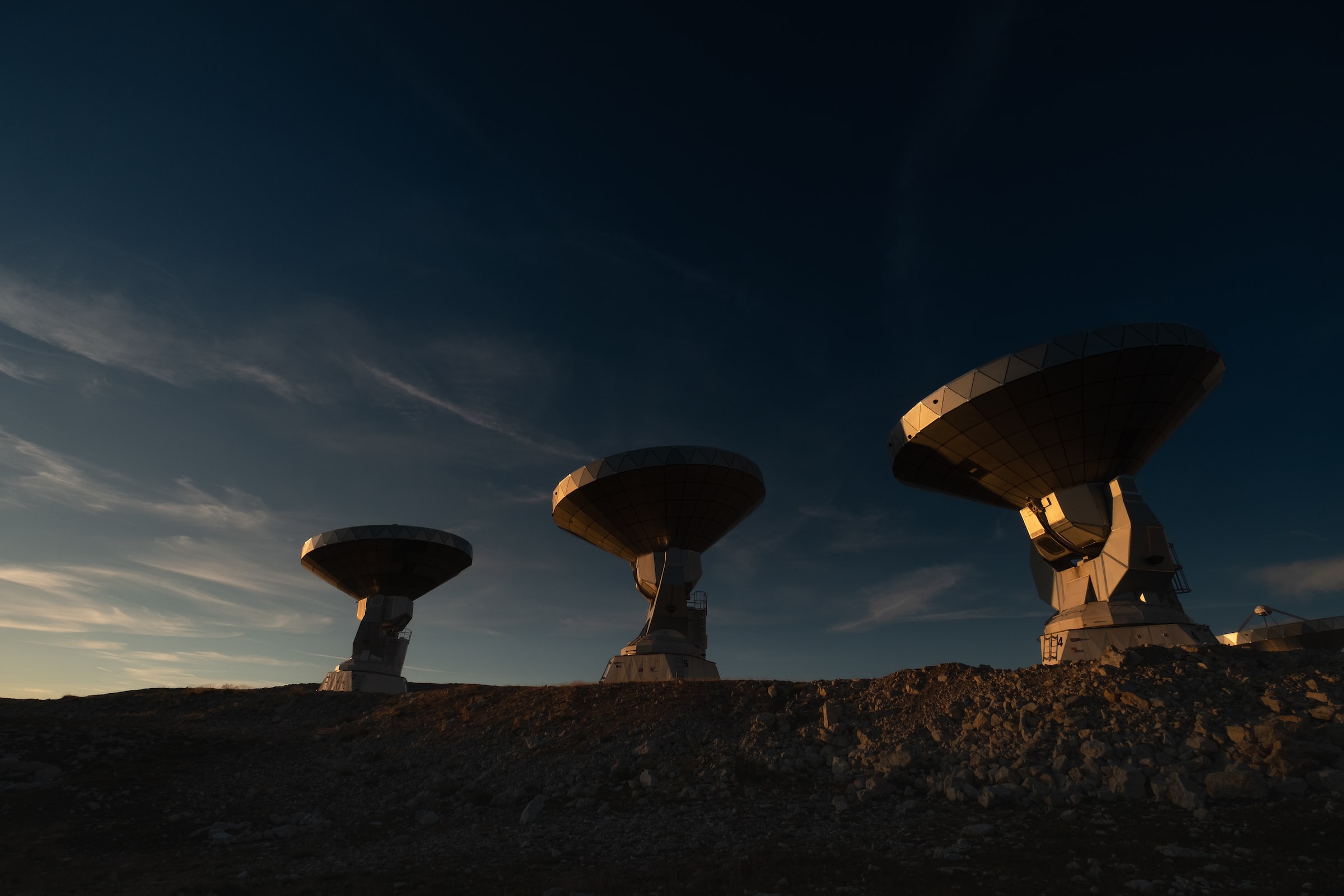
The 6-antenna interferometer “Plateau de Bure Interferometer (PdBI),” located on Pic de Bure (2550 m) in the French Alps
The criteria that must be applied to determine whether what we find outside of Earth, in space, is alive or not are well understood in science.
Even though NASA is searching for life on Mars today, it doesn’t really know exactly what it’s looking for.
Since Mars is a neighboring planet to Earth, life there could resemble what we have here. In fact, one hypothesis suggests that the origin of life on Earth might trace back to Mars. It’s possible that ancient bacteria arrived here inside meteorites broken off from nearby places like Mars. But the situation on the moons of Jupiter could be completely different. And that’s not even mentioning life born outside the Solar System, around other stars or in other galaxies.
So, currently, at its most fundamental level, what does our astronomical concept of life consist of?
It should be noted that living structures, in general, are contrary to the universe, or rather, to the course of the universe.
According to one of the fundamental laws of thermodynamics in physics, in a universe that is increasingly breaking down, meaning its disorder (which is inevitably increasing), or entropy, is increasing, the evolution of a living cell is a force acting in the opposite direction. Evolution has taken primitive protons and ions to cells, cells to tissues, organs, systems, organisms, humans, and even further, to communities, civilizations, consciousness, and the complexity capable of writing sentences about itself. All of this contradicts the universe’s general trend, the law of increasing entropy, which is a decrease of complexity.
From the perspective of physics, a living being, in the vast infinite scale of the universe, is an extreme micro-level deviation from order. I like to compare it to waves calmly rolling against the rocks on a seaside, suddenly flinging a single drop five meters into the air.
Because such deviations in space are extremely rare, the information (complexity) that emerges by chance cannot just start over every time; it must be passed on to the next generation, step by step, for further development. For that, a carrier is needed. On Earth, this is DNA. Elsewhere in the cosmos, it will likely be a system with a very different structure, or it might be. When astrobiology discovers this strange new molecule, the volume of fundamental biology books like Campbell Biology will increase by at least 25%.
Article by: Araz Zeyniyev, molecular microbiologist, head of the Habitat project
—
Mad cow disease (or medically known as “Creutzfeldt-Jakob” disease) - a neurological disorder caused by prions, found in large cattle and transmissible to humans. The disease leads to damage of nerve cells due to abnormal accumulation of proteins in the brain and manifests over time with symptoms like loss of coordination, muscle weakness, and other neurological signs.
DNA (deoxyribonucleic acid) - a biopolymer that stores hereditary information necessary for the formation and maintenance of living organisms and is passed from generation to generation. All organisms, including some viruses, contain DNA.
© 2026 Zəhra Kosmosda